
What Criteria / Rules Does Wordle Use for Its Answer List
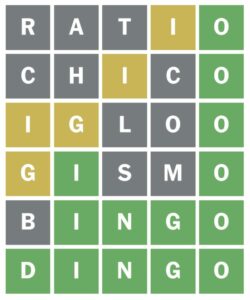
AFTER DINGO YESTERDAY (21 May 2024), I started to wonder about what words are on the Wordle Answer List? I thought Dingo was a proper noun, and I thought proper nouns can’t be used. So i went on a little adventure to find out how Wordle works.
How do words get onto the Answer List? What criteria is used for their inclusion? I figured I might have gone with Dingo earlier if I had known. Probably not :-)
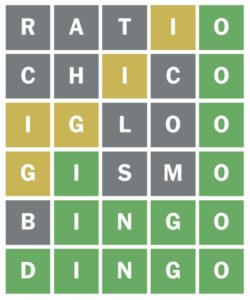
Here’s what I discovered:
FIRSTLY - WORDLE HAS TWO LISTS OF WORDS:
- The Answer List: this list contains all the words that can possibly be an answer. All of these will be in the other list, which is the:
- The Guess List: this list contains all the words you can use, to help you work out which letters work and don’t work. Note: not all words on this list will be on the Answer List.
RULES FOR THE ANSWER LIST:
-
ABOUT PROPER NOUNS: The ‘Answer List’ generally avoids words that function only as proper nouns. However, a word may still be used if it also has an established common-noun or ordinary-language meaning. This explains why DINGO is acceptable. It is an ordinary common noun, not the name of one specific dingo.
-
IT MUST BE A FIVE LETTER WORD: Nouns, verbs, adjectives, adverbs, prepositions, and conjunctions can be used as Wordle answers, as long as it’s a five-letter word.
-
ABOUT PLURALS: Plural forms of three- or four-letter words ending in “S” or “ES” are excluded as answers. Irregular plurals such as GEESE or FUNGI may still be used. For example, FOXES and SPOTS may be valid guesses, but they will not be answers.
-
ABOUT PAST TENSE VERBS: This is where I wish I had paid more attention in English class. Regular “-ed” verbs don’t get onto the ‘Answer List’. There’s an exceptions for adjectives, where words ending in “-ed” that also function commonly as adjectives (such as fried, or aged) can occasionally appear. Past-tense verbs that do not use “-ed”, such as found, broke, or wrung are valid answers. And of course, while “-ed” verbs are blocked from being the answer, you can still type them as a guess to test letter placements.
-
REGULAR PLURAL NOUNS AND REGULAR PAST TENSE NOUNS: Regular plural nouns and regular past tense words can be used as Wordle guesses (they’re on the ‘Guess List’) even if they aren’t valid Wordle answers (not on the ‘Answer List’).
-
AMERICAN ENGLISH SPELLING: Wordle uses the US English Dictionary.
-
OFFENSIVE OR SENSITIVE WORDS: The New York Times, which manages Wordle, has removed certain words deemed offensive, insensitive, or too obscure to ensure the game remains appropriate for a wide audience. That said, the ‘Answer list’ is editorially filtered. There is some evidence that the ‘Wordle boss’ may remove words that are too obscure, offensive, insensitive, regionally unfamiliar, or too closely associated with a current news event. The ‘Wordle boss’ also considers difficulty, repeated letters, the number of plausible alternatives, and whether solving the word depends too heavily on luck.
Hope that helps a little bit? The rules aren’t as definitive as some might like them to be.
BACK TO DINGO:
Dingo is a common noun. Proper nouns refer to a very specific thing.
It can get confusing, and I’m still a little confused, although not as much. Here’s one example that I still struggle with: Japan and China are common nouns and Korea is a Proper noun. One explanation (which hasn’t helped me, comes from the Washington Post:
Certain generic words are also absent from the game’s dictionary. “ASIAN” is not a valid entry. “KOREA” and “BURMA” cannot be used while “JAPAN” and “CHINA” can be.
“JAPAN and CHINA are both plain nouns in addition to being proper nouns,” wrote Cohen. “The same cannot be said of the other three examples, which are only proper nouns.”
WORDLE TIPS AND TRICKS
If you’re looking for tips and tricks to get ahead on Wordle, there are plenty of pages to search for. Here’s just one found useful on CNet.