
The Left-Brain/Right-Brain Myth, And the Stranger Truth Behind It
Published 28 October 2011 · Updated 18 September 2026
I was born left-handed. That definition was based purely on which hand I wrote with, and any sport using one hand (tennis, squash, throwing a ball, bowling, etc). However, I kick with my right foot, and I use a right-handed stance in all sports that requires two hands (golf, cricket, baseball, etc). So I’m not a thoroughbred.
On being left-handed, I always felt as though I was a bit of an outcast. Different to everyone else. Mostly because it was pointed out to me, not because I felt it.
Success and Failure
My success and failure record can be neatly divided into two parts:
Creativity and Sport: I played first team in most sports at junior and high school, and earned national colours for cycling (BMX). I’m often told I’m the most creative person in a room, and regularly sought out for alternative, off-the-wall ideas from colleagues and friends.
Academics, not so much. I’ve been, at best, average on that front, in every institution I’ve attended. My grade 11 report first 3 symbols spelled EGG (for English, Afrikaans and Maths). I never achieved a university degree (and I tried 3 times).
The Left-Brain/Right-Brain Prophecy
Don’t worry, I was told. You’re left handed. It’s expected. There’s a place for everyone.
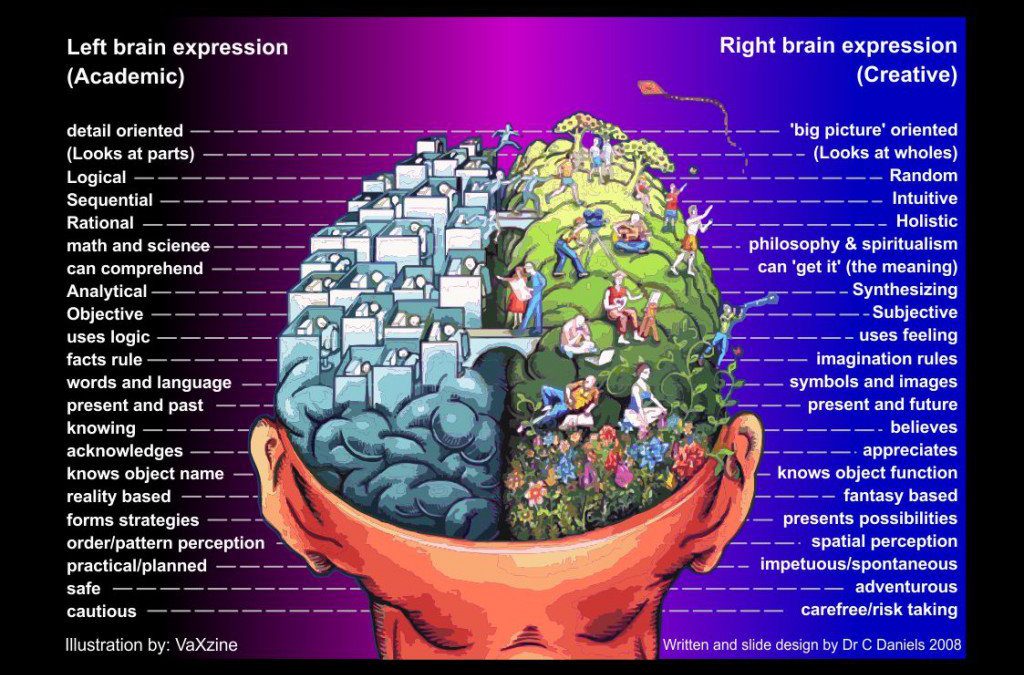
The theory to help me ‘accept’ who I was becoming is the Left-Brain / Right-Brain theory. Simply, it suggests left handers are dominant in the right-brain hemisphere, and right handers in the left-brain hemisphere.
Left-handers excel when it comes to the right-brain functions. Things like:
- Creative Expression
- Holistic Thinking
- Intuition
- Spatial Awareness
- Empathy and Emotion
- Spontaneity
Right-handers are dominant in the left-brain hemisphere, and they excel at things like:
- Logical and Analytical
- Strong with Numbers and Science
- Detail-Focused and Organised
- Skilled with Language
- Methodical Planners
- Reserved Emotionally
It was written in the stars. Hard-wired into my DNA. It wasn’t my fault, because this is how I was born. That’s a pretty heavy prophecy to drop onto a child. And it’s a tough one to carry with you through life.
Enter Iain McGilchrist and the Divided Brain
Back in 2011 I stumbled across an 11 minute video by Iain McGilchrist on the ‘divided brain’.
Who is Iain McGilchrist, and what was the video about:
Renowned psychiatrist and writer Iain McGilchrist explains how our ‘divided brain’ has profoundly altered human behaviour, culture and society.
He dismisses what he sees as some popular misconceptions about lateralisation of brain function, such as one hemisphere handling reason and the other language (etc), stating that such processing involves both sides of the brain.
As you might imagine, I sat down and gave it all the attention a left-hander can muster. I watched the clip (embedded below) three times to get my head around it (both halves, hahaha). Partly because it’s a massive chunk of information presented in a very short space of time, and because it exploded both what I believed about The Left-Brain / Right-Brain Theory, and more importantly, what I believed about myself (It’s well worth the 11 minutes it’ll take you to watch it.)
It’s Not What Each Side Does, It’s How They Look
Here’s the bit that actually rewired me: McGilchrist isn’t arguing that logic lives on the left and creativity on the right. He’s arguing the two hemispheres pay attention to the world in completely different ways. The left hemisphere narrows in: it isolates, categorises, grabs hold of the world to use it. The right hemisphere holds the wider field: open, watchful, alert to context. He illustrates it with chicks: one eye (and hemisphere) pecks for individual seeds in the gravel, while the other scans the open sky for a hawk. Both jobs matter. Neither one is “the creative one.” It was never a talent split. It’s a difference in focus.
Is It All Nonsense?
I won’t go into all the details, however, it is true that certain parts of the brain appear responsible for specific functions. As Robert H. Shmerling, MD writes in a Harvard Medical School Article, Right brain/left brain, right?:
For more individual personality traits, such as creativity or a tendency toward the rational rather than the intuitive, there has been little or no evidence supporting a residence in one area of the brain. In fact, if you performed a CT scan, MRI scan, or even an autopsy on the brain of a mathematician and compared it to the brain of an artist, it’s unlikely you’d find much difference. And if you did the same for 1,000 mathematicians and artists, it’s unlikely that any clear pattern of difference in brain structure would emerge.
It certainly is a popular theory, that in spite of increasing evidence, is showing to be severely outdated and difficult to support in a modern world with modern research tools.
As for me, I’ve been working hard, for years now, to undo the idea that I am heavily influenced by only half of my brain. I’m choosing to see myself as a full brained human person, who is not defined by a theory that dates back to at least 1960.
Nuf Sed